







01
Expert knowledge stays locked in individuals
The judgments veterans make as a matter of course are the least likely to be written down or captured as data. Every time people change, the strengths of the workplace are lost.
On Japan's manufacturing floors, there is knowledge that has not yet become AI.
Kiei structures that tacit knowledge and turns AI into real business outcomes.
We have led AI transformation for more than 100 companies, from strategy through implementation.
We envision a future of industry where people and AI work together, and aim to make Japan a nation of challengers again.
Kiei is a results-driven AI partner that goes all the way to the last mile.








Three walls we have seen again and again on the front lines of manufacturing and other core industries.
The judgments veterans make as a matter of course are the least likely to be written down or captured as data. Every time people change, the strengths of the workplace are lost.
It worked in the demo, but never became part of daily work. Without designing for users and operations, the investment never leads to the next step.
Paper, Excel, drawings, and the minds of veterans. The information you need is scattered, and progress stops at organizing it before it can be handed to AI.
From strategy and team launch to knowledge graph construction and RAG system design and implementation.
From structuring on-site challenges to drafting an AI roadmap and launching the team that drives it. We design AI strategy that connects management and the front line.
We structure scattered technical documents and tacit knowledge into a knowledge graph that can be searched and reasoned over, making your organization's intellectual assets visible.
We design and build RAG systems that leverage internal documents, quality-prediction AI, and more: AI that the front line keeps using.
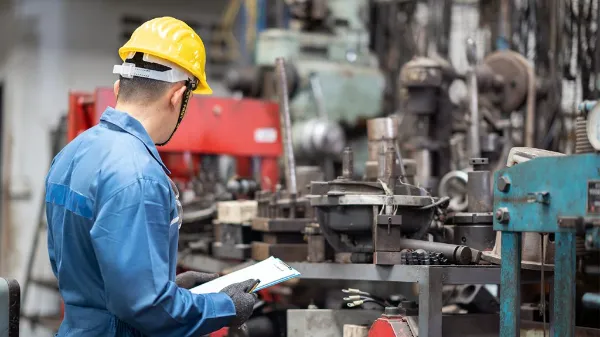
As skilled workers retire, techniques are lost, quality decisions depend on individuals, and equipment maintenance falls behind. We have tackled these structural challenges of the production floor by working directly on site.
We structure the tacit knowledge of the production floor as a knowledge graph and implement quality prediction and equipment failure prediction, reducing equipment support work by 70%, tripling the accuracy of quality warning signs, and shortening the training period for new staff by 40%. We digitize the judgment criteria of skilled workers and build an improvement cycle led by the front line.
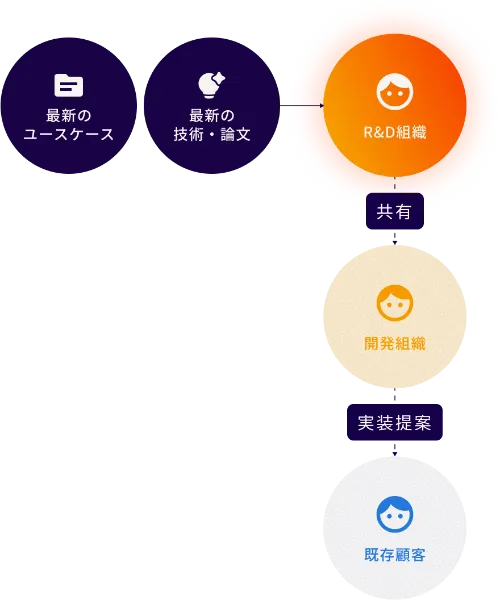
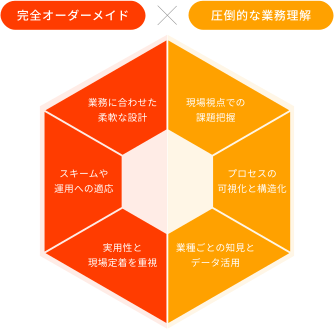
Instead of applying off-the-shelf tools as they are, we review current operations, users, and the data required before we design.
Our in-house R&D team evaluates AI technologies and RAG platforms and selects the technology that fits each project's requirements.
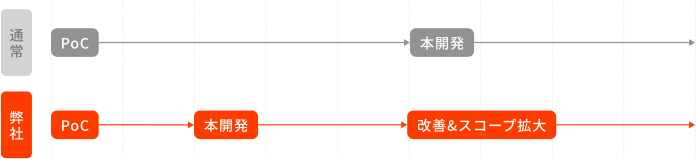
We focus on creating small, fast success stories through agile PoCs
Leveraging foundation models and the latest modules, we run agile PoCs with flexibility and create “success stories” quickly and on a small scale.
AI implementation examples by industry, including manufacturing, construction, healthcare, logistics, and local government.
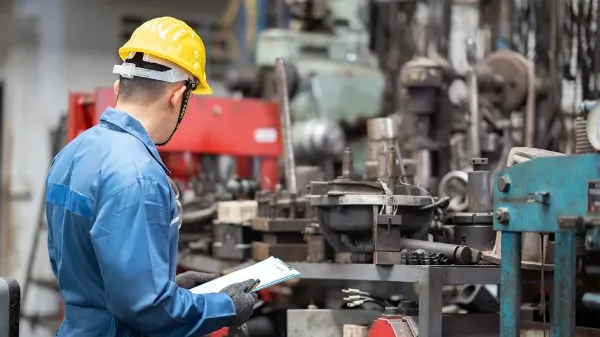
We collect and organize veteran engineers' know-how from paper documents, audio, and past work records, convert it into documents, and vectorize it into a searchable format, building a knowledge-sharing system where engineers can instantly find and use what they need.

Starting with organizing historical data and building an AI training foundation, we integrate estimation and construction records and digitize drawings and specifications for better searchability. On top of that, we deliver AI-driven automated estimation simulations, cost optimization, and risk analysis.
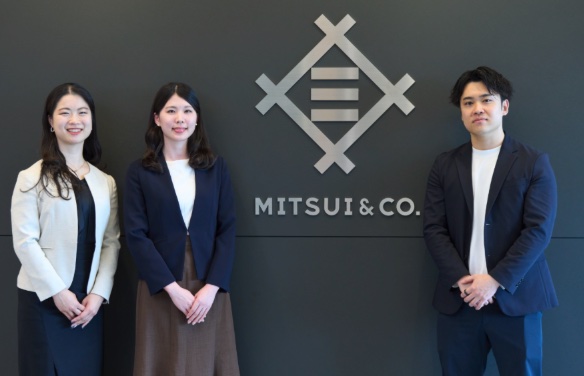
Logistics Strategy Division, Mitsui & Co., Ltd.
Challenge
Inconsistent quotation formats
Inquiries from business units and quotes from shipping lines arrived in different formats (email, Excel, PDF), and the parties could not agree on a standard. About 15 staff spent their time sorting conditions and transcribing data.
Effect
Target: 1,100 hours saved per year
A 20% reduction in the workload of the roughly 15 staff handling ocean freight quotations (equivalent to 1,100 hours per year) has been set as a KPI. Rollout is proceeding step by step, business unit by business unit.
Less registration work through natural-language input
Because AI structures and registers natural-language input, unifying formats is no longer necessary. The workload of handling inquiries is decreasing on both the requesting and the receiving side.

For those considering AI implementation rooted in business operations
We can help you choose which operations to apply AI to, develop the system, and run it after launch.
Contact us